Posts

John Fitzgerald Kennedy (1917-1963)

Image
President John F. Kennedy was assassinated in Dallas, TX on November 22, 1963, putting an abrupt halt to one of the most promising presidencies in American history. His Administration, later referred to as the Camelot Era, bespoke the spirit of American pride, ambition and know-how in post World War II.  His Administration sent the first man to the moon, tackled the nation's thorny civil rights issue, and stood its ground against the Soviet Union and other threats to American sovereignty. In the half a century since President Kennedy's death, he continues to inspire and instruct people everywhere about the merits of democracy, the value of public service, and the positive spirit of the human condition. For more information on his legacy, visit the John F. Kennedy Presidential Library & Museum in Boston's Columbia Point throughout the year. Read stories about the Kennedy Family's Irish heritage here. For year round details on Boston's Irish comm...

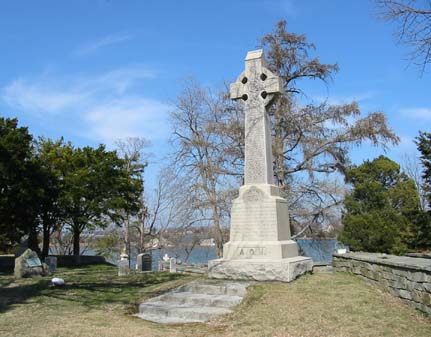
Boston Massacre Memorial Unveiled on Boston Common in November 1888

Image
The  Boston Massacre Memorial , located  on the Tremont Street Mall on Boston Common, commemorates the famous episode in which five men were shot by British soldiers in Boston on March 5, 1770.  The shooting and its aftermath helped launch the Revolutionary War. Putting up a monument to commemorate these men seemed like a good idea in the 19th century, and an number of citizens gathered together to do just that.   The memorial was unveiled on Wednesday, November 14, 1888.   Governor Oliver Ames attended, along with  Mayor Hugh O'Brien , the city's first Irish-born mayor of Boston.  The poem for the event was written by Irish-born poet  John Boyle O'Reilly .  E ntitled Crispus Attucks, the poem honored the African American who was one of the five martyrs killed that evening, along with Patrick Carr, an Irish immigrant, Samuel Gray, James Caldwell and Sam Maverick.   But surprisingly, there was opposition to the Memorial fro...

Galway ship the Brig St. John sinks off the coast of Cohasset, killing most of the passengers, in October 1849

Image
On the morning of Sunday, October 7, 1849, the Brig St. John sank off the coast of Cohasset, pushed to the brink by a severe nor-easter that rocked the boat for hours before it sank. On board were 127 passengers from Ireland, along with sixteen sailors. The majority of passengers were poor Irish immigrants fleeing the famine, Writer Henry David Thoreau heard about the wreck and traveled from Concord to witness the aftermath. He wrote about it in his book, Cape Cod . "We found many Irish in the cars going to identify bodies and to sympathize with the survivors, and also to attend the funeral which was to take place in the afternoon," Thoreau wrote. "When we arrived at Cohasset, it appeared that nearly all the passengers were bound for the beach, which was about a mile distant, and many other persons were flocking in from the neighboring country." Only 9 crew members and 11 passengers survived, according to reports . Most of the others drowned at sea,e...

Patrick S. Gilmore, Irish-born Bandleader, Dies on Tour in St. Louis on September 24, 1892

Image
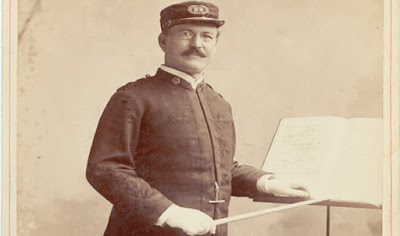
Patrick Sarsfield Gilmore (1829-1892), whose song When Johnny Comes Marching Home Again is considered one of America's iconic hymns, died on September 24, 1892 in St. Louis while on a national tour with his orchestra. Born in Ballygar, County Galway, Gilmore emigrated to Boston in 1849 and quickly established himself as an excellent cornet player and a band organizer.  He led several prominent bands in the 1850s and finally established his own Gilmore's Band. Gilmore and his band joined the Massachusetts 24th Regiment when the American Civil War broke out in 1861, and accompanied the soldiers to the battle front.  After the war ended Gilmore put together a giant Peace Jubilee in 1869 to celebrate peace.  The five-day music festival featured 1,000 musicians and 10,000 choral singers, and was attended by President Ulysses S. Grant. Then in 1872, Gilmore staged an even larger World Peace Jubilee to celebrate the end of the Franco-Prussian War.  He invited ...

John Barry, Revolutionary War Hero from Ireland

Image
Commodore John Barry   (March 25, 1745 – September 13, 1803) was a naval hero of the American Revolutionary War.  B orn in  Tacumshane, County Wexford in 1745, Barry emigrated to Philadelphia in 1760.  He joined the American forces at the outbreak of the war, and was the first Catholic appointed to command a vessel by the Continental Congress.  Barry's ship,  Lexington , was the first to capture a British vessel under the American flag. During much of the war, Barry commanded ships out of Boston Harbor, including the  Delaware  and the  Alliance . After the war,  President George Washington  assigned Barry to help create the United States Navy.    Barry settled in Philadelphia  and died there at age 59.  He is buried at St. Mary's Churchyard on S. Fourth Street. In 1949, Boston Mayor James Michael Curley spoke at the  Charitable Irish Society  annual dinner on March 17, and  vowed to buil...

Labor Day Profile of Maurice J. Tobin, US Secretary of Labor under President Truman

Image
Photo courtesy of the Harry S. Truman Library This Labor Day, the  Boston Irish Tourism Association  pays tribute to Boston native  Maurice Tobin  (1901-53), who served as mayor of Boston and governor of Massachusetts before being named US Secretary of Labor by President Harry S. Truman . Born in Roxbury's Mission Hill,  he was the son of immigrants from Clogheen, Tipperary. Tobin became Massachusetts' youngest state representative at age 25, and in 1937 made a surprise run for mayor against his mentor,  James Michael Curley . Tobin defeated Curley in 1937 and again in 1941, serving through 1944.  He then won the race for Governor of Massachusetts, and  served as Governor  from 1944-46.  Governor Tobin advocated for the Fair Employment Practices Bill, and helped increase unemployment insurance and benefits for workers. He helped campaign for President Truman, who appointed  Tobin as US Secretary of Labor  from 19...

10,000 Attend the Boston Calendonian Festival in West Roxbury on August 5, 1916

Image
Over 10,000 people attended the 63rd Scottish picnic hosted by the Boston Caledonian Club at the West Roxbury Grove on Saturday, August 5, 1916. According to  The Boston Globe , there were 39 athletic and cultural events, ranging from track and field and football (soccer) to Scottish dancing and Bagpipe competitions. The Caledonian handicap road race of 13 ¼ miles started in front of the State House and finished at the Grove.  “The 16 starters were the crack local marathoners and Mayor Curley sent them off on their grind at 1:45,” wrote the Globe. Mayor James M. Curley  then traveled to the festival, where he addressed the crowd briefly and enjoyed the activities.  At one point, reported the Globe, Curley “was so pleased with the dance of one of the girls that he gave a personal prize.” In addition to the sports and cultural competitions, three prizes were also awarded for “Best Dressed Highlander,” which was won by George A. Mitchell. ...