Posts

18th Century Painter John S. Copley Born in Boston to Irish Immigrant Parents, Born on July 3, 1738

Image
America's first great portrait artist, John Singleton Copley (1737-1815) was born in Boston on July 3, 1738. He was the son of Irish immigrants who emigrated to Boston in the 1730s. John's parents, Richard Copley and Mary Singleton from County Clare, were married in County Limerick before emigrating to Boston. Right after their son John was born, Richard Copley traveled to the West Indies and died shortly thereafter, leaving John’s mother to raise him as a widow. She worked at a shop in Boston that sold tobacco close to Boston Harbor. In 1747 Mary S. Copley married Peter Pelham, a colonial artist and an original member of the Charitable Irish Society formed in 1737. It was Pelham who helped to nurture his stepson John's talent, and by age twenty Copley had gained a reputation as a promising artist. His first painting, "A Boy and the Flying Squirrel," was sent to the Royal Academy in London and his reputation began to take shape. Copley seized the oppo...

Irish American Song & Dance Man George M. Cohan Born on July 3, 1878

Image
George M. Cohan , famed Broadway song and dance man whose songs helped define the World War I generation, was born in Providence RI on July 3, 1878.   A  statue honoring Cohan  at the corner of Wickendon and Governor Streets in Providence   was created by noted sculptor  Robert Shure , who also created   the  Irish Famine Memorial in Boston  and in  Providence .  Cohan (1878-1942) was the son of Jeremiah Cohan from Boston and Nellie Costigan from Providence.  They met met on the vaudeville circuit and married in 1874.  George and his sister Josephine became part of a successful family troupe, named the Four Cohans, which traveled around the country on the minstrel circuit, performing a cabaret of songs, dances, jokes and comedy routines popular at the time.  In 1893 George settled in New York City and soon became the  toast of Broadway , writing popular tunes like Yankee Doodle Dandy, You're a...

Irish 9th Regiment of Massachusetts Presented Flag to Governor Andrew in June 1861

Image
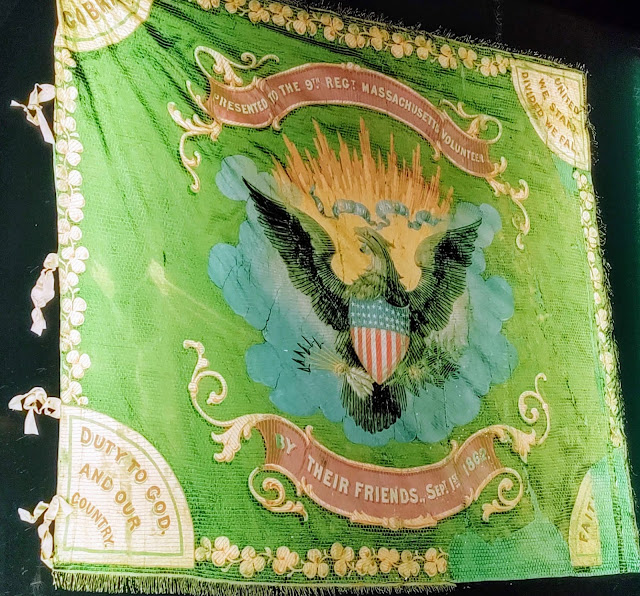
An estimated 150,000 Irish fought on the Union side in the American Civil War, including two Irish regiments from Massachusetts: the Ninth Regiment of Infantry, Massachusetts Volunteers and the 28th Irish Massachusetts Regiment. The 9 th Regiment's flag was first publicly displayed on June 25, 1861 when Colonel Thomas Cass made a formal visit to Governor Andrew to receive the state flag.  The Ninth Regiment sported an Irish flag made of green silk, with a scroll inscribed in gold that read: "Thy sons by adoption; they firm supporters and defenders from duty, affection and choice." On June 30, 1861, the 9th arrived in Washington D.C., where they were welcomed by President Abraham Lincoln. The Ninth Regiment saw extensive battlefield action in Virginia and Pennsylvania.  When Colonel Cass was mortally wounded at the Battle of Malvern Hill in Virginia in 1862, he was replaced by Colonel Patrick R.Guiney of Tipperary, who continued to distinguish the Regime...

President John F. Kennedy Bids Farewell to Ireland, June 29, 1963

Image
A high point of President John F. Kennedy’s time in office was his official visit to Ireland on June 26-29, 1963. The visit captured the world’s imagination and shone a spotlight on the new Republic of Ireland. The visit was a triumphant, emotionally charged promenade in which the entire population of Ireland seemed to participate. Kennedy’s motorcade passed regally through the streets of Dublin, Cork, and Galway as thousands of proud Irish cheered him with tears of joy in their eyes, and the twin flags of Ireland and the United States waved madly for him. The President’s eight great-grandparents all migrated to Boston, Massachusetts during the Potato Famine of the late 1840’s, seeking to take advantage of the economic opportunity offered in America. By the end of the century, both of President Kennedy’s grandfathers had become successful Boston politicians. Patrick J. Kennedy was a tavern owner and later a banker who served in both Houses of the Massachusetts Legislatur...

Boston Irish Leader John Boyle O'Reilly Born on June 28, 1844

Image
Courtesy NY Public Library  John Boyle O'Reilly , considered one of Boston’s true leaders in speaking, writing and campaigning for human rights, oppressed people and injustice, was born on June 28, 1844 in County Meath, Ireland.  Conscripted into the British Army as a young man, O'Reilly was charged with sedition against the British Crown and sentenced to life imprisonment in an Australian penal colony.  O’Reilly made a daring escape aboard a New Bedford whaler,  Gazelle , in 1869, a feat that helped shape his legend by the time he landed in America.   When he arrived in Boston in 1870, he was infatuated by the possibilities of democracy and liberty.   He spent the next twenty years of his life, until his death in 1890, speaking out on behalf of Irish, African-Americans, Native Americans, Jews, Chinese and other beleaguered groups trying to make their way in America. As editor and then owner of  The Pil...

Boston's Irish Famine Memorial Unveiled on June 28, 1998

Image
The Boston Irish Famine Memorial was unveiled on Sunday, June 28, 1998, before 7,000 people, including the governor of Massachusetts, mayor of Boston and government officials from Ireland.   A Vietnamese and Rwandan were among the speakers of the day, an acknowledgment of modern day refugees who continue to seek solace in Boston. The Memorial by artist Robert Shure juxtaposes an Irish family starving in Ireland with another Irish family striving for success in America.   Eight narrative plaques encircling the statues tell the story of the famine and the Irish triumph in America. The $1 million memorial park commemorates the 150 th anniversary of the Irish Famine (1845-49), during which one million people died of starvation or disease and nearly two million fled Ireland to avoid death.  Over 100,000 Irish refugees arrived in Boston during this time, transforming the city. Their arrival revealed deep-seeded hostility among some Bostonians...

Boston's World Peace Jubilee, with 22,000 Musicians & Singers, Had its Grand Finale on July 4, 1872

Image
In the summer of 1872,  Boston  staged the largest concert in history at that time, featuring over 2,000 musicians and 20,000 singers, performing as soloists, in various ensembles and also  en masse , to convey the joy, comfort and inspiration that music can bring. The World Peace Jubilee and International Music Festival ran from June 17 through July 4, 1872, housed in a temporary coliseum that was built in what is now  Copley Square  in  Boston ’s  Back Bay .  In addition to the 22,000 performers, the stadium held 60,000 spectators, and it was filled to capacity on many of the 18 days in which the Jubilee ran. The Jubilee was created by Irish immigrant Patrick S. Gilmore, a talented cornet player, band leader and impresario who had become the best known musician in  America .  Gilmore had been Band Master for the Union Army during the Civil War and is credited with penning the song,  When Johnny Comes Mar...