Posts

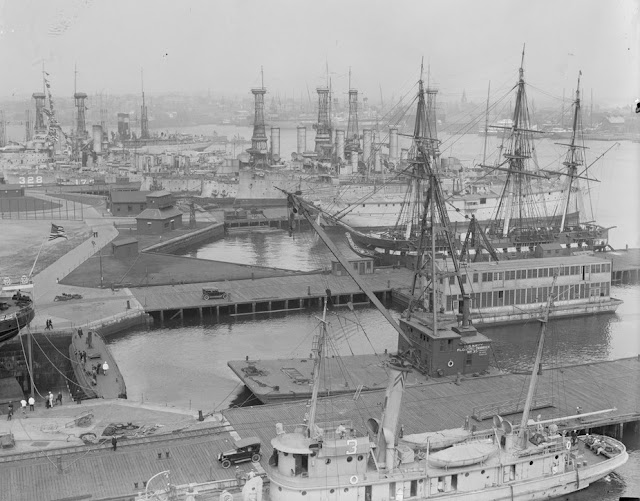
Boston Longshoremen and Irish Women Protest British Ships at Charlestown Navy Yard on September 1, 1920
Image
Photo Courtesy of Digital Commonwealth On September 1, 1920, more than 100 dock workers at Charlestown Navy Yard boycotted British Ships in sympathy with the Boston Irish who were protesting against Britain's treatment of Ireland. Bostonians were upset about the hunger strike of Terence MacSwiney , lord mayor of Cork, Ireland, who had been sentenced to two years in prison by British authorities. He went on a hunger strike on August 12 to protest his imprisonment and was rapidly declining in heath. He died on October 20, 1920. Photo from Boston Globe, September 1, 1920 As longshoremen were loading the British ship Nitonian, there was picketing on the docks by two women, Mrs P. H. Savage and Miss Amelia Rosser, niece of General Thomas Rosser, according to The Boston Globe. The women were joined by Irish leader John P. McCarthy, an Irish leader, who exhorted the crowd, asking if they were going to handle British goods and telling them they must tie up British shipping.  "A lar...

Irish-American Sculptor John Donoghue (1853-1903) Dies Tragically after his Masterpiece is Destroyed on Brooklyn Docks

Image
New York Daily Herald Front Page, August 2, 1903 One of the most gifted 19th century Irish-American sculptors, according to art historians, was John Talbott Donoghue (1853-1903) , a Chicago native who lived in Boston in the 1880s and whose life and career ended tragically when he took his own life.  Donoghue was discovered as a struggling artist by Oscar Wilde during the famous Irish writer's trip across America in 1882. Wilde reported he met "a young sculptor whom we would love and be so proud of if he were in Europe. He reminded me of the old Italian stories of the struggles of genius." Wilde wrote that he found Donoghue "in a bare little room at the top of a great building, and in the center was a statuette of the young Sophocles, a piece of the highest artistic beauty and perfect workmanship…. It was by far the best piece of sculpture I have seen in America." Image courtesy of  Isabella Gardner Museum  in Boston Donoghue's most celebrated work is The...

Patrick Keely, a Pioneering Architect of Catholic Churches in America

Image
Holy Cross Cathedral in Boston, image courtesy of Elkus Manfredi Patrick C. Keely (1816-1896), regarded as one of the great neo-Gothic church architects of the 19th century, designed more than 600 churches and 16 cathedrals throughout the United States between 1846-1896.  Born in Thurles, County Tipperary on August 9, 1816, Keely was the son of an architect and skilled carpenter who built St. Patrick's College and the Fever Hospital in Thurles. The family, spelled Kiely in Ireland, originated from Kilkenny.  He emigrated to New York in 1842 at age 25 and settled in Brooklyn. Inspired by 13th century Gothic design and influenced by English architect Augustus Pugin, he used elements such as Marcello towers and pinnacles, and within a short time was the most sought after church architect in America. In addition to Catholic churches, Keely also created notable Protestant churches such as the Asylum Hill Congressional Church in Hartford, CT, which included parishioners Mark...

The Sudden Death of Irish Patriot and Poet John Boyle O'Reilly on August 10, 1890

Image
Poster Courtesy of Boston Irish Tourism Association Irish patriot, poet, scholar and athlete John Boyle O'Reilly died suddenly at his summer home in Hull, Massachusetts on August 10, 1890, from an accidental overdose of medication taken for insomnia.  For the two decades he lived in Boston, since arriving in January 1870, O’Reilly had quickly become an influential writer, orator, advocate and sage, especially for the city’s large Irish population and the Black community. He was beloved by the literati, business and political establishments, church leaders, and by ordinary people everywhere, who recognized his authenticity, dignity and good-will.  St. Mary's Church, Charlestown His funeral was held at St. Mary's Church on Warren Street in Charlestown, right around the corner from his home at 34 Winthrop Street.  The church was full to the brim, and participants included his wife Mary and four daughters, Elizabeth, Mary, Agnes and Blanid, and hundreds of friends, coll...

Boston Writer Elizabeth O'Reilly wrote Classic Travel Book in 1922, How France Built Her Cathedrals

Image
One of the most extraordinary travel books about France was written by Elizabeth Boyle O’Reilly (1874-1922) of Charlestown, Massachusetts, the daughter of celebrated Boston Irish poet and editor, John Boyle O'Reilly and writer Mary Murphy O'Reilly .  She died a few months after the book was published, on September 11, 1921, in New York City, where O'Reilly was living in her final years How France Built Her Cathedrals: A Study in the Twelfth and Thirteenth Centuries  (1921) was published by Harper Publishing in July, 1921, in New York City. The 600 page book, with illustrated drawings by A. Paul De Leslie, was based on O'Reilly's extensive research and travels throughout France. Title Page:  How France Built Her Cathedrals "Of living interest to the erudite devotee of the arts and to the person who simply enjoys, in books or travels, the wonderful and beautiful things that have come from the hand of man," wrote the  Boston Herald .  Boo...

The First Annual Greater Boston Feis, Devoted to Irish Music, Dance, Sports and Language, Was Held in Malden on July 30, 1950

Image
  Boston Irish Stepdancers On Saturday, July 30, 1950, the Greater Boston Feis was held at Malden Municipal Stadium in  Malden ,  Massachusetts, the first feis ever held in New England.  More than 15,000 spectators attended. The feis, described as an ancient Irish tradition in music and dance, sports, language and knowledge, was part of a cultural rekindling of Irish traditions taking place in Ireland and Diaspora communities after World War II and since Ireland became a Republic in 1949. Greater Boston Feis, program booklet, July 30, 1950 The bilingual program book, printed in English and Irish, was organized by the Central Council of Irish County Clubs, Inc, with  Richard J. Cardinal Cushing , Archbishop of Boston, listed as the event’s patron. Schedule of competitions Over 1,500 contestants participated in 72 different events, ranging from competitions in accordion, violin, harp, piano and Irish war pipes.     Among the winners were Joe Derrane...

Boston's Noted Civil War Sculptor Martin Milmore Dies at 39 on July 21,1883

Image
Martin Milmore (1844-1993), considered one of America's most talented and consequential sculptors in the late 19th century, died at his home in Boston on July 21, 1883, at age 39. Born in Kilmorgan, County Sligo on September 14, 1844, he was the youngest of five brothers born to Martin Milmoe and Sarah Hart.  When the father died, Sarah and her five sons emigrated to Boston in 1851, where Sara's sister Ann was living.  They lived on Warren Street in the South End before moving to Hammond Street in Roxbury.  Martin showed an early inclination for art at the Martin Brimmer School on Common Street, where he was encouraged by his teachers and by Headmaster Joshua Bates.  It was here that one of Martin's teachers seemingly encouraged the family to change its name from Milmoe to Milmore, to align more closely with a popular Boston musician and bandleader at the time, Patrick S. Gilmore . After grammar school Martin attended Boston Latin School , graduating in 1860.  ...