Posts

Christmas Gift Idea in Boston, December 1871: Gilmore's History of the National Peace Jubilee

Image
Patrick S. Gilmore's signature book, History of the National Peace Jubilee and Great Musical Festival, was advertised as a Christmas gift idea by the Boston Evening Transcript in December 1871 leading up to Christmas.   The 758-page, 6 x 9" volume, published by Gilmore himself, was released in late summer 1871 and which sold for $5.00 by Lee & Shepard, a publishing and bookselling firm on Washington Street in Boston.  The book was an exhaustive account of the National Peace Jubilee, which took place in Boston on June 15-19, 1869, a musical celebration of peace devised by Gilmore himself to mark the aftermath of the Civil War. More than 1,000 musicians and 10,000+ vocalists performed during the five-day Jubilee in the section of Boston now known as Copley Square.  U.S. President Ulysses S. Grant attended the event,  and top musicians included violinists Ole Bull and Carl Rose and vocalists Madame Parepa-Rosa and Adelaide Phillips.  Despite early c...
Irish Patriot Timothy Deasy Died in Lawrence, MA on December 10, 1880

Image
Timothy Deasy (1839-1880), Civil War soldier, Irish rebel and elected official, died on December 10, 1880 in Lawrence, MA.  Deasy emigrated with his family from Clonakilty, County Cork to Massachusetts in 1847 to escape the Irish Famine. The family settled in Lawrence 35 miles north of Boston, the nation's first planned industrial city where immigrants and Yankees worked long hours in mills and factories.  The Deasy family had long been involved in Irish political insurrections, starting with the United Irishmen Uprising of 1798. In Lawrence, Timothy and his younger brother Cornelius joined the Irish Republican Brotherhood, formed in 1858 as a physical force movement to oust Britain from Ireland.   When the Civil War started, they enlisted in the 9th Massachusetts Volunteer Infantry in 1861. Both brothers were wounded in May 1864, but continued to fight with their unit. After the war, Deacy and 300 veterans went to Ireland in 1865 to train Irish soldiers for...

BOSTON TOURISM GROUP ISSUES FREE TRAVEL & CULTURE MAGAZINE WITH CHRISTMAS & WINTER ACTIVITIES

Image
(BOSTON) -- The Boston Irish Tourism Association (BITA) has released its winter 2021-2022 issue of Travel & Culture, a compendium of Irish concerts, culinary, cultural and literary activities taking place in Massachusetts and throughout New England, as well as travel tips to Ireland.  The magazine is distributed FREE at visitor kiosks and cultural venues throughout Massachusetts and is available in digital format online on BITA’s home page.  Read the digital magazine here .   This issue features stories about Christmas and holiday concerts including shows at the Irish Cultural Centre, Blackstone River Theatre, Boston Symphony Hall, Shalin Liu Performance Center and various New England cultural venues. And it includes winter and St. Patrick’s Day activities leading up to March 2022, from parades and concerts to cultural events and dining specials.  The “Ireland” section has focuses on Tourism Ireland’s new “ Press the Green Button ” campaign to bring New Engla...

OTD, December 5, 1770, Two British Soldiers Found Guilty of Manslaughter for Boston Massacre

Image
  " On December 5, 1770, nine months to the day after the Boston Massacre , Matthew Kilroy and Hugh Montgomery were found guilty of manslaughter for the killing of Crispus Attuck s; the other seven soldiers were exonerated. At their sentencing on December 14, both men invoked a medieval English plea for mercy called “the benefit of clergy,” originally offered to clergy and later extended to felons facing a first conviction. The plea involved showing their God-fearing ways by reciting Psalm 51; both Kilroy and Montgomery did so and thus had their execution commuted. They were branded with an M for murder on their thumbs and were released back into their regiment. Years later, when Governor Thomas Hutchinson’s diaries became public, it turned out that Hugh Montgomery had admitted to his lawyers that it was he who yelled out the fatal call to "fire" that helped start the American Revolution." Excerpt from  Irish Boston,  2nd edition, Published by   Rowman & Littlef...

On November 23, 1885, Boston unveiled memorial to Irish Patriot John E. Kelly

Image
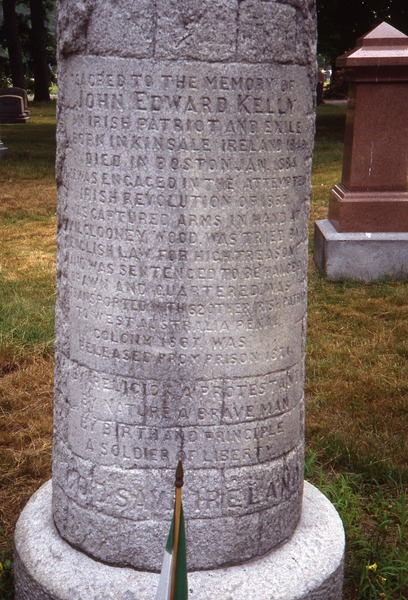
Photo by Barbara Rotundo On November 23, 1885, a monument to the Irish patriot John Edward Kelly was formally dedicated at Boston’s Mount Hope Cemetery in Mattapan. Fellow Irish patriot John Boyle O’Reilly gave the impassioned oratory at the ceremony.   A native of Kinsale, Ireland, Kelly emigrated as a youngster with his parents to Nova Scotia and he eventually moved to Boston, and later New York, where he became involved in the Fenian movement brewing in the US.   Kelly returned to Ireland to help stage an uprising in 1867 but was captured during the Fight at Kilclooney Wood. He was sentenced to life imprisonment to a penal colony in western Australia at age 19.  In 1871, Kelly was among Fenian prisoners released in the British Government’s general amnesty, according to the Fenian Graves website. He lived in many places but eventually made his way back to Boston. When he died in January 1884, he was in poor health from the living conditions at the prison ...

Roxbury's John F. Collins, Mayor of Boston from 1960-1967, Professor at MIT

Image
John Frederick Collins (1919-1995) served as Mayor of Boston for two terms, from 1960 to 1967.  Born in Roxbury on July 20, 1919, his father, Frederick “Skeets” Collins was a mechanic for the Boston Elevated Railway.  Collins attended Suffolk University and served in World War II, and after the war married Mary Patricia Cunniff.   Collins traced his family ancestry to Roscommon, and was a longtime member of the County Roscommon Benevolent Association. Elected to the House of Representatives in 1947, representing Jamaica Plain, Collins ran for City Council in 1955.  During that race, he and his four children were struck by the polio virus.  The children recovered, but Collins himself became paralyzed and never walked again.  He won the election and in 1959, when Mayor John B. Hynes announced he would not seek another term, Collins was a long-odds candidate against the popular John E. Powers, the state senate president from South Bos...

Cardinal O'Connell Parkway Dedicated in Lowell on November 17, 1918

Image
On November 17, 1918, more than 30,000 people gathered in Lowell to honor a favorite native son, William Henry Cardinal O'Connell, who was at that time the Cardinal of the Boston Archdiocese. Officials unveiled and dedicated a fountain of granite and bust of O’Connell along a parkway in front of City Hall. The fountain and bust were designed by Henry L. Rourke of Lowell.   Prior to the unveiling and in the pouring rain, a massive parade took place through the city, as described in the Lowell Irish blog .   At the unveiling, Lowell industrialist Humphrey O’Sullivan addressed O’Connell and the crowd, “For years we have been involving in our minds how to give expression to our love and fealty for your Eminence,” he said. “This beautiful fountain and bust erected in your honor, represent in concrete form the pent-up love and esteem we have in our hearts, which also finds expression in this great gathering.” Cardinal O’Connell said, “It is natural for a man to rejoice...