Posts

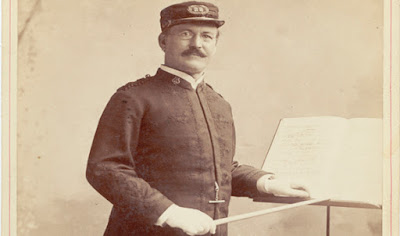
Patrick S. Gilmore, Irish-born Bandleader, Dies on Tour in St. Louis on September 24, 1892
Image
Patrick Sarsfield Gilmore (1829-1892), whose song When Johnny Comes Marching Home Again is considered one of America's iconic hymns, died on September 24, 1892 in St. Louis while on a national tour with his orchestra. Born in Ballygar, County Galway, Gilmore emigrated to Boston in 1849 and quickly established himself as an excellent cornet player and a band organizer.  He led several prominent bands in the 1850s and finally established his own Gilmore's Band. Gilmore and his band joined the Massachusetts 24th Regiment when the American Civil War broke out in 1861, and accompanied the soldiers to the battle front.  After the war ended Gilmore put together a giant Peace Jubilee in 1869 to celebrate peace.  The five-day music festival featured 1,000 musicians and 10,000 choral singers, and was attended by President Ulysses S. Grant. Then in 1872, Gilmore staged an even larger World Peace Jubilee to celebrate the end of the Franco-Prussian War.  He invited ...

John Barry, Revolutionary War Hero from Ireland

Image
Commodore John Barry   (March 25, 1745 – September 13, 1803) was a naval hero of the American Revolutionary War.  B orn in  Tacumshane, County Wexford in 1745, Barry emigrated to Philadelphia in 1760.  He joined the American forces at the outbreak of the war, and was the first Catholic appointed to command a vessel by the Continental Congress.  Barry's ship,  Lexington , was the first to capture a British vessel under the American flag. During much of the war, Barry commanded ships out of Boston Harbor, including the  Delaware  and the  Alliance . After the war,  President George Washington  assigned Barry to help create the United States Navy.    Barry settled in Philadelphia  and died there at age 59.  He is buried at St. Mary's Churchyard on S. Fourth Street. In 1949, Boston Mayor James Michael Curley spoke at the  Charitable Irish Society  annual dinner on March 17, and  vowed to buil...

Labor Day Profile of Maurice J. Tobin, US Secretary of Labor under President Truman

Image
Photo courtesy of the Harry S. Truman Library This Labor Day, the  Boston Irish Tourism Association  pays tribute to Boston native  Maurice Tobin  (1901-53), who served as mayor of Boston and governor of Massachusetts before being named US Secretary of Labor by President Harry S. Truman . Born in Roxbury's Mission Hill,  he was the son of immigrants from Clogheen, Tipperary. Tobin became Massachusetts' youngest state representative at age 25, and in 1937 made a surprise run for mayor against his mentor,  James Michael Curley . Tobin defeated Curley in 1937 and again in 1941, serving through 1944.  He then won the race for Governor of Massachusetts, and  served as Governor  from 1944-46.  Governor Tobin advocated for the Fair Employment Practices Bill, and helped increase unemployment insurance and benefits for workers. He helped campaign for President Truman, who appointed  Tobin as US Secretary of Labor  from 19...

10,000 Attend the Boston Calendonian Festival in West Roxbury on August 5, 1916

Image
Over 10,000 people attended the 63rd Scottish picnic hosted by the Boston Caledonian Club at the West Roxbury Grove on Saturday, August 5, 1916. According to  The Boston Globe , there were 39 athletic and cultural events, ranging from track and field and football (soccer) to Scottish dancing and Bagpipe competitions. The Caledonian handicap road race of 13 ¼ miles started in front of the State House and finished at the Grove.  “The 16 starters were the crack local marathoners and Mayor Curley sent them off on their grind at 1:45,” wrote the Globe. Mayor James M. Curley  then traveled to the festival, where he addressed the crowd briefly and enjoyed the activities.  At one point, reported the Globe, Curley “was so pleased with the dance of one of the girls that he gave a personal prize.” In addition to the sports and cultural competitions, three prizes were also awarded for “Best Dressed Highlander,” which was won by George A. Mitchell. ...

Boston Parks Department Created Irish Floral Design in Public Garden to Welcome AOH Convention

Image
Scene from the Boston Public Garden, ca. 1916   Photo Courtesy of Digital Massachusetts In July, 1916, the  Boston Parks & Recreation Department  created a floral design of an Irish harp in Boston's  Public Garden  to welcome the national convention of the  Ancient Order of Hibernians .  The convention took place on July 19-23 and attracted over 50,000 delegates, many from the mid-Atlantic and mid-Western states. According to a  Boston Globe  story on July 2, 1916, a number of local residents complained about the Irish arrangement to John H. Dillon, chairman of the Parks Department and  James M. Curley , mayor of Boston . Dillon "explained that it has always been his policy to plant in the Public Garden an emblem of any large organization holding its convention in Boston , but up to the present instance of the harp no objection has ever been made.  He recalled that last year the emblem of the Zionists was ...

Irish Art Adorns the Boston Arts Festival in the Public Garden on June 6, 1954

Image
Madonna and Child by Rev. Jack Hanlon The third annual Boston Arts Festival , which opened in the Public Garden in downtown Boston on June  6, 1954, featured a tent devoted to "works by contemporary Irish artists" chosen by Ireland's Cultural Relations Department. The Irish tent contained "24 paintings and a tapestry by some of Ireland's top-notch contemporary artists.  Some work is in the abstract vein, some semi-abstract, and more romantic." The Boston Globe  story by Edgar J. Driscoll, Jr. called the festival "the largest and most comprehensive display of the arts in the city's history."   The festival was comprised of twelve tents, "housing hundreds of thousands of dollars worth of art," Driscoll wrote. The Ireland tent included works by "a painting priest, Rev. Jack P. Hanlon, who is represented by a Madonna and Child and a landscape inspired in County Kerry.  Others whose work has been sent here through the co...

Cardinal O'Connell, Mayor Curley at St. Ambrose Church Dedication in Dorchester, May 28, 1916

Image
Photo Courtesy of the Dorchester Atheneum On Sunday, May 28, 1916, William Cardinal O'Connell "blessed the walls of the new Church of St. Ambrose in Dorchester," according to a report in the Republic Newspaper. It was the 11th Catholic Church in Dorchester, wrote the Republic . The parish had been formed on December 4, 1914,and founding Father John P. Harrigan broke ground for a lower church in March 1915.  According to  The Boston Globe , church services were initially held at the Dorchester Theatre and in the old Dorchester Post Office prior to the church being completed. On this day, Cardinal O'Connell, assisted by Father Harrigan, confirmed over 200 children from Dorchester at the service.  Nearly 100 members of the Knights of Columbus escorted the Cardinal and his  entourage to and from the ceremony.  The St. Vincent's Boys Cadets of South Boston were also present, the media reported. Among the guests were Mayor James M. Curley and his...