Posts

The Shaw Memorial Unveiled in Boston on May 31, 1897

Image
Boston’s most iconic public monument, the Shaw Memorial, was officially unveiled on May 31, 1897.  The homage to the 54th Black Infantry Regiment of Boston is considered one of America’s most significant Civil War memorials.   It was the first public monument to accurately depict black soldiers in military uniform. The memorial was created by immigrant Augustus Saint-Gaudens (1848-1907), considered by many to be America’s greatest sculptor of the 19 th century.  The memorial was unveiled on Memorial Day, located near the site where Civil War regiments mustered on Boston Common before going off to war. Notable guests at the ceremony included acclaimed Black inventor and leader Booker T. Washington, philosopher and writer William James, along with veterans of the 54 th Regiment and the families of the soldiers.   It took Saint-Gaudens fourteen years to complete the memorial, partly because there was an early disagreement within the memor...

Charlestown Selectmen Refuse to Bury Catholic Children in the Town, 1832

Image
Photo by Stephen O'Neill "On May 19, 1832, Boston's Catholic Bishop,  Benedict Fenwick  attempted to bury two Boston children, three-year-old Florence Driscoll, who died from teething, and three-month-old James Kinsley, who died from infantile disease, at the recently opened  Bunker Hill Catholic Cemetery  in the town of Charlestown, Massachusetts, right across the bridge from Boston. "The obligation to make the request in writing was unusual, but the town selectman had passed a ruling the previous November, in an effort to keep Irish Catholics from being buried in Charlestown. The townsfolk feared that the Irish would bring religious superstitions and disease to their town. In the nineteenth century the entire world was worried about the spread of diseases. "Fenwick’s request to bury the children was denied the same day it was written by Selectman Nathan Austin, who stated, “The object of the town in adopting the rule was to prevent the bringin...

Boston Olympians Are Celebrated at Faneuil Hall on May 13, 1896

Image
The Boston athletes who triumphed in the first Modern Olympics in Athens, Greece were feted by an enthusiastic crowd of family, friends and supporters with a reception in their honor at Faneuil Hall, followed by a banquet at the Vendrome Hotel on May 13, 1896. Local poet  Henry O'Meara  wrote a special tribute, "To Our Laureled Sons," which was recited and later sung by Irish tenor Joseph White. The team's manager was  John Graham , and the track and field athletes were  Thomas E. Burke ,  Ellery H. Clark ,  Thomas P. Curtis ,  W.W. Hoyt   and  Arthur Blake , representing the  Boston Athletic Association;  and  James Brendan Connolly , representing the Suffolk Athletic Club in South Boston.  Connolly had remained in Europe after the Olympics and was not at the celebration. Attending the banquet with other dignitaries were Governor  Roger Wolcott  and Boston Mayor  Josiah Quincy , according to a story in...

Boston Hosts its first Irish festival, Feis Ceoil Agus Seanachas, in May 1900

Image
Boston's Irish-American community, inspired by Ireland's literary revival and the renaissance of the Irish language at the turn of the 20th century, organized its first Feis Ceoil Agus Seannachus, or Festival of Music and Story, on Sunday, May 6, 1900 at the Hollis Theatre, located between Washington and Tremont Streets in downtown Boston. The festival was organized by a number of local Irish societies, including the Gaelic Society and the Philo-Celtic Society of Boston.  Language enthusiast Professor Fred Norris Robinson of Harvard's Gaelic department also participated. A musical highlight of the festival was the performance by Ireland's famous baritone William Ludwig ,who specialized in interpreting ancient Irish airs.  Reverend Eugene O'Growney sang the "Star Spangled Banner" in Gaelic, and Patrick Harney played a selection of tunes on the uilleann pipes, according to The Boston Globe .   Other musicians included Irish harpist Nona Conveney ...

Galway Immigrant Edward White, noted Uilleann Pipe Maker in 19th Century Boston

Image
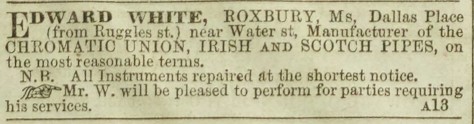
    Ad in 1853 by Michael Quinlin Edward White (1807-1877), who emigrated from Loughrea, Galway to Roxbury, Massachusetts in 1848, was a notable figure in Boston’s Irish music community, and a successful businessman as well.   Based at Dallas Place (off of Ruggles Street) in Roxbury, White was a musical instrument repairman, whose specialty was the uilleann pipes, then referred to commonly as the union pipes or Irish bagpipes.   During this time, Roxbury was a separate city next to Boston, and would later be annexed to Boston as a neighborhood in 1868. Throughout the 1850s, White ran a regular advertisement in the Boston Pilot , the nation’s leading weekly newspaper.  The Pilot catered to the city’s growing Irish population, but also had a national following of readers.   White’s ads ran over 225 times between 1853 and 1860. Ad in 1859 "Edward White, manufacturer of the union Irish and Scotch bag pipes…. ca...

Irish Rebels Take over Dublin on April 24, 1916

Image
Flag of the Irish Citizens Army On Tuesday, April 24, 1916, Irish insurgents objecting to British rule in  Ireland  had taken over parts of the City of  Dublin, including the General Post Office in the center of the city. "Post Office Seized, Telegraph Wires Cut, Soldiers Killed," blasted the headline in the Fall River Daily Evening New s on April 25, 1916. The rebellion was led by a collection of volunteer organizations including the Irish Republican Brotherhood, Sinn Fein, the Irish Volunteers and the Irish Citizens Army.   Throughout the day, the Irish rebels took possession of several different sections of the city.  An official British communication, published in  The Boston Globe , read: “A large party of men identified with the Sinn Fein party, mostly armed, occupied Stephen’s Green and took possession forcibly of the Post Office, where they cut the telegraph and telephonic wires.  Houses were also occupied in Stephen’s G...

J.J. McDermott of New York Won the first Boston Marathon in 1897

Image
John McDermott This year's   Boston Marathon , slated to take place today, is being postponed to September 14, 2020 because of the COVID-19 pandemic. The annual race is sponsored by the  Boston Athletic Association  (BAA).  The very first Boston Marathon was held on April 19,1897, inspired by the first modern Olympic Games held the previous year in Athens, Greece.  Thomas E. Burke , who won first place in the 100 and 440 yard races at the Athens Olympics in 1896, was the official starter of the race.  "At 12:15, Tom Burke scrapped his foot across the narrow street in front of Metcalf's Mill and called the contestants numbers," reported The Boston Globe.   The race was organized by the BAA, and the initial field that year consisted of fifteen runners, of whom ten would finish the race.    John J. McDermott  of the Pastime Athletic Club of New York won the race, finishing the 25 mile course in two hours, fifty-...