Posts

Pipers Greet Fiddlers at Boston Docks in March 1926

Image
  John Wiseman of Bantry Bay and James Scott Skinner of Aberdeen arriving in Boston in March, 1926 On March 21, 1926, two top traditional fiddlers from the British Isles, 82 year old James Scott Skinner of Aberdeen, Scotland and 76 year old John Wiseman of Bantry, County Cork, arrived in Boston Harbor aboard the Cunard liner Carolina.  They were here to compete in  the World's Old Fiddlers Contest, taking place April 5-10, 1926 in Lewiston, Maine.   Upon their arrival, they were met by a host of    fiddlers, pipers and dancers from the Irish and Scottish communities, who serenaded the two musicians and greeted them enthusiastically.  Sisters Nora and Violet Twomey, both pipers, posed with the fiddlers on the docks. Wiseman became ill on the journey over and had to be hospitalized in Boston after he arrived.  Despite medical advice, he journeyed to Maine in a car accompanied by two nurses, one of whom stood next to him on stage as he gamely pl...

Four St.Patrick's Day Parades in Massachusetts on March 20, 2022

Image
 Here are the final four parades taking place in Massachusetts in March 2022, as part of St. Patrick's Day celebrations and Irish American Heritage month:  Abington, MA/ Sunday, March 20 at 1 p.m.  Boston, MA/ Sunday, March 20 1 p.m.  Holyoke, MA/ Sunday, March 20 at Noon  Scituate, MA/ Sunday, March 20 1 p.m.  In addition to the parades, find a schedule of Irish concerts, dances, literary events and social activities by visiting  BITA's March calendar page.   For information on visiting Dublin, Ireland during St. Patrick's Day season, go to  Ireland.com . To learn about Boston's illustrious Irish history and heritage, visit  IrishHeritageTrail.com .

August Saint Gaudens, America's Greatest Sculptor, was Born in Dublin, Ireland on March 1, 1848

Image
One of America’s most acclaimed sculptors of the 19 th  century was actually an Irish immigrant.  Augustus Saint-Gaudens (1848-1907) was born on March 1, 1848 on Charlemount Street in Dublin at the height of the Irish Famine, when millions of Irish were fleeing Ireland to places like Boston, New York, Montreal, St. John and other eastern port cities.   His father Bernard Saint-Gaudens was a French cobbler who had "a wonderfully complex mixture of a fierce French accent and Irish brogue."  His mother, Mary McGuinness, was born in Bally Mahon, County Longford, to Arthur McGuinness and Mary Daly. According to his son Homer, when Augustus was six months old, "the famine in Ireland compelled (the family) to go to America."  They landed in Boston in September 1848, where they lived for six weeks until the father found work in New York City and sent for them.  Augustus apprenticed as a cameo cutter, and in 1867 moved to Paris...

Massachusetts’ Irish Round Tower in Milford Build by 19th Century Irish Immigrants

Image
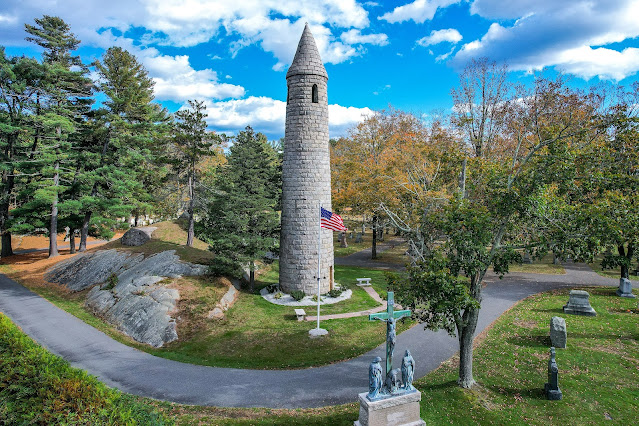
  The town of Milford Massachusetts has its own iconic Irish Round Tower , built in the 19th century by Irish immigrants who came to the Blackstone Valley Region to work in the rock quarries and on railroad construction.   The Milford tower is about 65 feet high and 16 feet in circumference. Early media reports suggest that the tower was modeled after the notable round tower in Glendalough, County Wicklow ; the Milford tower is approximately half the size of Glendalough.  Round towers were monastic structures dating back to the 9th century in Ireland. The Irish monks likely used them for defense from invaders, as well as for  solace and contemplation, and for storing valuable objects like bells, religious artifacts and hand-written manuscripts. Because of their slenderness, many were destroyed by lightning or even high winds. Today there are approximately 65 round towers in Ireland , in various states of condition, but many of the well preserved as histor...

Revolutionary War Hero General John Sullivan Born in New Hampshire on February 17, 1740

Image
General John Sullivan, who led the Siege of Boston from  Dorchester Heights  in March 1776,  forcing British troops to withdraw from Boston, was born in Somersworth, NH on February 17, 1740.   Sullivan was the third of five sons born to Owen Sullivan of Limerick and Margery Browne of Cork, both indentured servants from Ireland. He and his brothers were home-schooled by their father, who had been a teacher in Ireland.  His brother James Sullivan was governor of Massachusetts.  John became a lawyer, served in the New Hampshire legislature, and was chosen as a member of the First Continental Congress in 1774 and the Second Continental Congress in 1775.  As the Revolutionary War escalated, Sullivan was selected as one of General George Washington’s eight Brigadier Generals in the Colonial Army.  When Henry Knox delivered the cannons from Fort Ticonderoga in New York to Massachusetts in the winter of 1776, Sullivan commanded a brigade during the...

Irish Rebel Maud Gonne Describes Boer War British Atrocities During New England Speaking Tour in February 1900

Image
  One hundred and twenty-two years ago in February 1900, Irish rebel, activist and poetic muse Maud Gonne , came to New England to tell Americans about the atrocities of the British in South Africa's Boer War.   After arriving in New York City on January 30, Gonne made her way to New England, making stops at New Haven, Pawtucket, Lowell, Fall River and Boston.  She spoke forcefully about British refugee camps filled with women and children, and described efforts by Irish and Irish-Americans to fight alongside the Boers. Gonne's husband, Major John MacBride, led the Irish Transvaal Brigade on the side of the Boers during the war. They were married in 1903 and divorced in 1905.  Known as Ireland's Joan of Arc, Gonne was renowned for her beauty and fiery disposition.   The Boston Globe  described her as "picturesque in a black velvet gown with a silver girdle at the waist...her splendid voice extremely musical."  Illustration of Maude Gonne...

Henry Knox Delivers Ticonderoga Cannons to George Washington in Cambridge in January 1776

Image
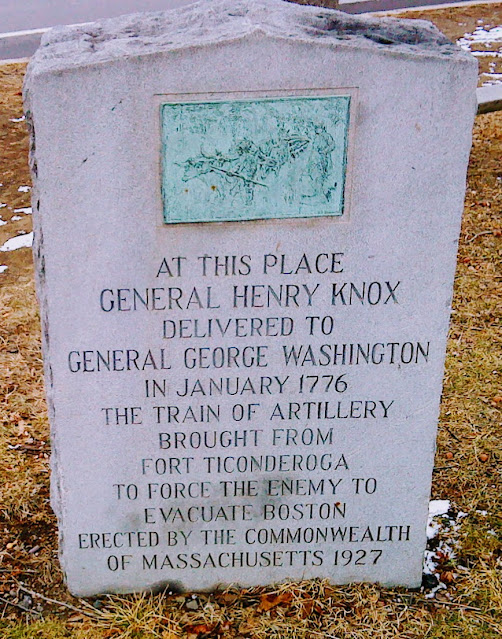
  Knox Trail Marker in Cambridge, MA  On January 24, 1776,   25 year old Boston bookseller and American revolutionary war hero Henry Knox reported to General George Washington in Cambridge that he  and his volunteers had just transported 59 cannons and artillery  300 miles,  from Fort Ticonderoga in  New York  to  eastern Massachusetts, in the dead of winter .   Image Courtesy of  Marching the Knox Trail The plan was to position the cannons atop  Dorchester   Heights  in South Boston and aim them at the British fleet in  Boston   Harbor .    On March 5, British General Howe saw the guns aiming down at his fleet, and by March 17, 1776, the British troops, along with their sympathizers, evacuated Boston, ending the eleven month Siege of Boston. The daring standoff was known as Evacuation Day, and is still celebrated in Boston each March 17th.  Read more about Dorchester Heights . Knox ...