Posts

Showing posts matching the search for Boston public library

Exhibit of Children's Books in the Irish Language presented by Boston Public Library in March, 1989

Image
In March, 1989, the Boston Public Library's presented a month long exhibit entitled, Turas Go Tir (Journey of the Land of Youth): An Exhibition of 20th century Children's Books in Irish, March 1-31, 1989. The exhibition featured children's books in the Irish language published in the 20th century, and were part of the Alice M. Jordan Collection, named for the first supervisor of children's services at the Boston Public Library.  Jordan was described in a local paper as "one of a wave of female librarians who crusaded for more public access to children's books, as well as better children's books, with missionary zeal in the 1920s."     "Alice Jordan was the first Supervisor of Children’s Services in the Boston Public Library . Historic, contemporary, and international titles are included with the complete works of authors and illustrators represented as well as various editions of fairy tales and old and new classics. The collection contains pictu...
Notes on Irish-American Sculptor Louis St. Gaudens, Creator of the Marble Twin Lions at Boston Public Library

Image
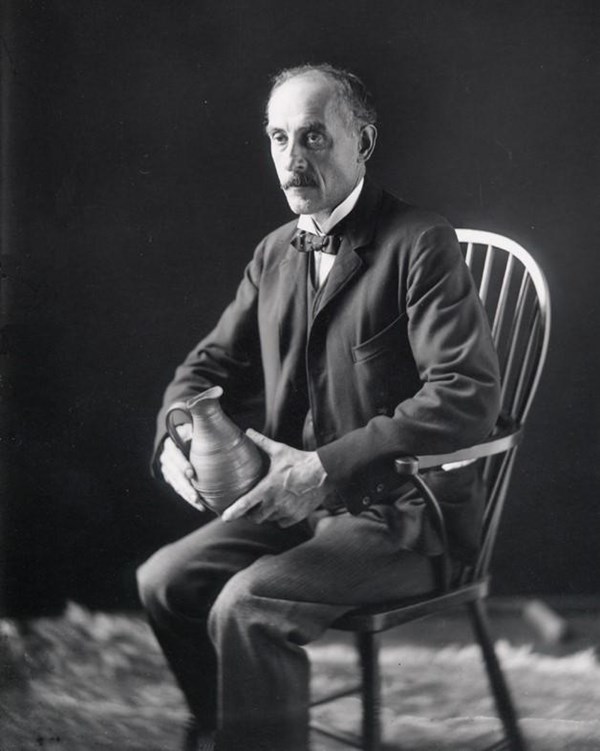
Portrait of Louis St. Gaudens,  photo courtesy of Saint Gaudens National Historical Park  Louis St. Gaudens (1854-1913), whose iconic sculptures grace the American landscape today, was born in New York City on January 8, 1854. He was the son of Bernard Saint-Gaudens from France and Mary McGuinness from Ireland, and the brother and protégé of his older brother Augustus, considered the preeminent American sculptor of his generation.   The family had emigrated from Dublin to Boston in September 1848, fleeing the Irish Famine.  They stayed in Boston for about six months before moving to New York City, where they settled. Among the most revered works of Louis are the twin lion statues in the foyer of the Boston Public Library; a statue of Greek poet Homer in the Main Reading Room Rotunda of the Library of Congress; six allegorical figures encircling Union Station in Washington, DC, and 46 Roman legionnaire statues inside the station. Louis was schooled in the art of scul...

In 1924, Ireland gives Boston Public Library an 8-Volume War Memorial Records of Nearly 50,000 Irish Who Died in World War I

Image
In February, 1924, the Irish National War Memorial Committee in Dublin donated eight beautifully decorated folio volumes, containing information on Irishmen who died in World War I to the Boston Public Library central branch in Copley Square. Published in 1923 by the Committee of the Irish National War Memorial, the the massive project was undertaken to ‘perpetuate the names and personalities of over 49,400 Irishmen w ho fell in the Great War.’ The book was illustrated by noted Irish illustrator and stain glass window artist  Harry Clarke , who did the artwork for various book authors including Edgar Alien Poe and Hans Christian Andersen.  The book was printed on handmade paper.  Only 100 sets were printed for distribution " among the principal libraries of Ireland," wrote  The Boston Globe,  "in carrying out the movement started in Dublin in June, 1919, by Field Marshal French, Earl of Ypres, then Governor General of Ireland, for a fitting memorial of Ireland's...

Boston Public Library Commission Proposes a Hibernica Room to House its Vast Irish Collections

Image
  The Boston Public Library Centennial Commission considered a proposal in February 1954 to create a Hibernica Room at the Copley Square library, to house the vast amount of material on the history, social and economic development, biography, and literature of the Irish, particularly of the progress and achievement of persons of Irish birth and ancestry in America. The Boston Public Library Centennial Commission was formed in 1953 to reflect upon the library's first hundred years and to chart a course for the future, which included plans to increase the library's spending budget for new books and eventually to expand the library to accommodate the growing needs of its constituents. The proposal for a Hibernica Room was presented at a meeting at the library, according to a Boston Globe columnist Bernadine Truden. "The project was presented most persuasively by Paul E. Tierney, chairman of the Irish-American committee; Patrick F. McDonald, president of the Library trustees;...

A Walk Through Irish Boston

Image
by DAVID D. HASKELL, United Press International (UPI) BOSTON, March 14, 2001 -- The Irish Heritage Trail is not just another tourist attraction in Boston, but a reminder that oppressed people can turn tragedy into triumph. The trail tells the story of the Boston Irish through a 3-mile walk that visits parks, memorials, cemeteries and public buildings. "The trail reveals a succession of Irish leaders who excelled in their chosen field, be it politics, literature, art, music, entertainment or sports," said Michael P. Quinlin, who runs the Boston Irish Tourism Association. With 26 percent of its residents claiming Irish ancestry, Massachusetts is the most Irish state in a nation in which there are some 44 million people of Irish heritage. Boston, the state capital, is also considered by many to be the capital of Irish-America for a variety of reasons, and not just because 22 percent of its residents are of Irish descent. It is the closest U.S. port to Ireland. It had a steady, u...

Boston Public Library Owns Rare 19th Century Irish Music Manuscript

Image
The Boston Public Library owns a rare five-volume collection of Irish traditional music created in the 1840s by a medical doctor, editor and music lover in Dublin, Ireland.     The hand-written manuscripts belonged to Dr. Henry Philerin Hudson (1798-1889), a medical doctor who was also passionate about Irish music,  collecting tunes throughout his life.  In total, there are over 1,100 Irish tunes in the set, although some are duplicates.   Hudson died in 1887, and the five-volume manuscript was eventually donated to the Boston Public Library in 1902.  The collection is part of the Allen A. Browne Music Collection . A note in the frontmatter reads:    These volumes came to the library from Nassau Massey, 89 Patrick St., Cork.  He says in a letter (undated, written in late 1902) that he has books “from the library of Dr. Hudson” and “also his original collection of Irish airs in five volumes many of them collected by h...

On December 9, 1884, Boston Elected Corkman Hugh O'Brien as its First Irish-Born Mayor

Image
A new era in city government took hold on Monday, January 5, 1885, when Hugh O'Brien became Boston's first Irish-born mayor. O'Brien's victory at the polls in December finally broke the hegemony of old-line Yankees who had run local government since Boston was incorporated as a city in 1822. O'Brien defeated incumbent mayor Augustus Pearl Martin by 3, 124 votes, with more than 52,000 citizens casting their votes. Once Mayor Martin heard the news, he sent a note to O'Brien cordially congratulating him on his victory. O'Brien said in a statement that evening: “As I have been elected, I am ready to assume the responsibilities of the position fearlessly and in good faith. In this connection I will say emphatically that there is no ring behind me, and there never will be. The nomination was tendered to and accepted by me without pledges of any kind, or of any name or nature. After living In Boston for upwards of half a century, being educated in her schools an...

James Michael Curley, Boston's Irrepressible Political Chieftain, Died on November 12, 1958

Image
  Twin Statues of James Michael Curley on Union Street, across from Boston City Hall  James Michael Curley, known as the Purple Shamrock, the Rascal King and the Mayor of the Poor, died on November 12, 1958 from pneumonia. Over 100,000 people passed by his coffin in the Hall of Flags at the Massachusetts State House to pay their respects. A dominant figure in Boston and Massachusetts politics for half a century, Curley served four four-year terms as mayor of Boston, in 1914, 1922, 1930 and 1946. He was Governor of Massachusetts from 1935-37, and served as US Congressman from 1911-14. He was born on November 20, 1874 on Northampton Street in Roxbury to Irish immigrant parents Michael Curley and Sarah Clancy from County Galway. In his autobiography, I'd Do It Again, published in 1957 by Prentice Hall Publishers, Curley conveys his humble beginnings and his rise to fame. "The Clancys and the Curleys, joined the Galway colony in Roxbury, formerly known as The Highlands," he...

Frederick MacMonnies' Once-Controversial Sculpture at the Boston Public Library

Image
One of Boston’s most interesting sculptures,  Bacchante and Infant Faun , is displayed in the courtyard of the  Boston Public Library  in Copley Square, Back Bay.  The masterpiece was created in 1893 by American-born sculptor  Frederick MacMonnies , a disciple of  Augustus Saint-Gaudens . MacMonnies gave the original casting to his friend, architect  Charles Follen McKim , whose own masterpiece, the Boston Public Library, was being built.  McKim in turn offered it as a gift to the Library, which installed it.  But an outcry ensued from opponents who objected to the nudity of Bacchante, the Goddess of Wine, and McKim withdrew the gift, giving it instead to the  Metropolitan Museum of Art in New York City. The controversy over the censorship of the artwork gained MacMonnies a certain notoriety, and he made numerous replicas of the work which he sold to museums and bronze statuettes, which he sold wholesale to...

Irish-American Sculptor John Donoghue (1853-1903) Dies Tragically after his Masterpiece is Destroyed on Brooklyn Docks

Image
New York Daily Herald Front Page, August 2, 1903 One of the most gifted 19th century Irish-American sculptors, according to art historians, was John Talbott Donoghue (1853-1903) , a Chicago native who lived in Boston in the 1880s and whose life and career ended tragically when he took his own life.  Donoghue was discovered as a struggling artist by Oscar Wilde during the famous Irish writer's trip across America in 1882. Wilde reported he met "a young sculptor whom we would love and be so proud of if he were in Europe. He reminded me of the old Italian stories of the struggles of genius." Wilde wrote that he found Donoghue "in a bare little room at the top of a great building, and in the center was a statuette of the young Sophocles, a piece of the highest artistic beauty and perfect workmanship…. It was by far the best piece of sculpture I have seen in America." Image courtesy of  Isabella Gardner Museum  in Boston Donoghue's most celebrated work is The...

An Irish Presence in the Boston Public Garden

Image
Established in 1837 as the nation’s first public botanical garden, Boston’s Public Garden is one of the city’s most cherished open spaces, with majestic swan boats gliding across a lagoon, seasonal flower arrangements delighting visitors, statues of important Bostonians and the iconic Make Way for Ducklings statues that delight children of all ages.  The 24-acre park is maintained year-round by the Boston Parks and Recreation Department with support from the Friends of the Public Garden .  The Public Garden is a stop along the Boston Irish Heritage Trail, a collection of landmarks from the waterfront to Fenway Park that takes you on a 300+ year journey through the city's illustrious history.  In 2026-27 we are adding new stops on our original trail, including these landmarks in the Public Garden. Swan Boats  Public Garden Lagoon  The majestic swan boats in the Public Garden lagoon were created in 1877 by Irish immigrants, Robert Paget and his wife Julia (Coffe...

Boston Hero John Boyle O'Reilly Dies on August 10 in Hull, Massachusetts

Image
John Boyle O'Reilly, one of Boston's most accomplished citizens, died on August 10, 1890 in Hull, Massachusetts, from an accidental overdose of medication. His sudden death marked the end of an amazing life of heroism, advocacy, leadership and literature that helped transform the city and the nation. Arriving in Boston in 1870, O'Reilly spent the next 20 years reconciling the city's racial and ethnic factions who struggled against one another. He became editor and then owner of The Pilot, the leading Irish Catholic paper in America, using the paper as a bully pulpit to advance various causes. He befriended the Yankee establishment while admonishing them for the prejudices. O'Reilly defended American Blacks who were still looking for post Civil War equality. He welcomed new immigrants such as Italians, Jews and Chinese, insisting that they get the same privileges as nativist Americans. Throughout his life he pursued freedom of Ireland from Britain, adv...