Posts

May 19, 1832: Request to Bury Irish Children in Charlestown, Massachusetts Refused by Town Selectman

Image
  Photo courtesy of Stephen O'Neill "On May 19, 1832, Boston's Catholic Bishop, Benedict Fenwick attempted to bury two Boston children, three-year-old Florence Driscoll, who died from teething, and three-month-old James Kinsley, who died from infantile disease, at the recently opened Bunker Hill Catholic Cemetery in the town of Charlestown, Massachusetts, right across the bridge from Boston. "The obligation to make the request in writing was unusual, but the town selectman had passed a ruling the previous November, in an effort to keep Irish Catholics from being buried in Charlestown. The townsfolk feared that the Irish would bring religious superstitions and disease to their town. In the nineteenth century the entire world was worried about the spread of diseases. "Fenwick’s request to bury the children was denied the same day it was written by Selectman Nathan Austin, who stated, “The object of the town in adopting the rule was to prevent t...

Boston Irish Dancers Holding Fundraiser for the Richard Family in Aftermath of Boston Marathon

Image
Boston's Irish dance community is coming together to raise funds for the Richard family of Dorchester, whose lives were severely affected by the Boston Marathon bombing. The event, Dance for Jane ,  is taking place on Saturday, April 27, 2013 at 7:00 p.m. at the John Hancock Hall in Boston's Back Bay.  Tickets to the event, which must be purchased in advance, are $26.20 and can be ordered online . The Richard family is well-known and beloved in Dorchester for its community work and friendship, and suffered severely from the bombing.  Eight year old son Martin Richard was killed at the scene.  His seven year old sister, Jane, lost her leg. She is a stepdancer at the Clifton Academy of Irish Dance in Milton.Their mother Denise suffered head injuries at the finish line where they were standing. To find out more information, visit the Dance for Jane Facebook page.   If you are unable to attend and would like to donate, please send a check to ...

Boston Marathon Gets Underway Today

Image
(photo courtesy of Bill Brett, The Boston Globe)  As thousands of runners take off for the annual Boston Marathon on Monday, April 15, 2013, we salute the late John Adelbert Kelley, one of the greatest competitors in the history of the race. Kelley was born in 1907 in West Medford, outside of Boston, and traces his ancestry to County Wexford.  "My father's people left to go to Australia," he told The Boston Globe in 1981, when he was preparing for his 50th   race.  "The boat stopped in Boston and they never left."  Kelley ran his first marathons in 1928 and 1932 but did not finish either race.  He ran again in 1933 and has since competed in every single race through 1992!  He finished in the top 10 eighteen times, taking first place in 1935 and again in1945.  He owns the record for the most races started (61) and the most finished (58).  His best time was two hours and thirty minutes, posted in 1943.  He was 84 w...

James B. Connolly of South Boston wins first medal in the modern Olympic Games in Athens, April 6, 1896

Image
On April 6, 1896, James Brendan Connolly of South Boston became the first medalist in the modern Olympic Games when he won the triple jump on the opening day of the Games in Athens, Greece. He won the event - back then it was called the Hop, Skip and Jump - by jumping 44 ' 9 3/4", beating the second place finisher by nearly six feet.  After his final jump, the audience began chanting his name and yelling Nike, the Greek word for victory, according to Connolly's teammate, Ellery H. Clark. Connolly and his American teammates nearly missed their events - they arrived in Athens thinking they had twelve days to prepare, only to realize that the Greeks used the Julian Calendar, not the Gregorian Calendar, and his event was that afternoon.  Connolly later recounted the story in his autobiography: Sea Borne: Thirty Years Avoyaging . Connolly also competed in the 1900 Olympic Games in Paris, and took second place in the Triple Jump.  Beverly Cronin of the Boston Herald...

Civil War History: Massachusetts Irish Regiment Musters on December 13, 1861

Image
(Image courtesy of 28th Massachusetts Volunteer Infantry) The 28th Massachusetts Volunteer Infantry - comprised of Irish-Americans and Irish emigrants - officially mustered into service on December 13, 1861 at Camp Cameron in Cambridge, Massachusetts. Governor John A. Andrew appointed Colonel William Monteith leader of the regiment. About 1,000 men were mustered on this day, the majority of them Irish-Americans and Irish emigrants.  They joined the state's other Irish fighting battalion, the 9th Regiment , and distinguished themselves in battle throughout the course of the American Civil War, fighting at Second Bull Run, Gettysburg, Frederickburg and Antietam.  One of the main supporters and fundraisers behind the formation of the 28th Regiment was Patrick Donahoe , publisher of the Boston Pilot newspaper.   In his book, Civil War Boston , Professor Thomas O'Connor writes that the soldiers voted to informally call themselves The Donahue Guard in honor of the...

Goody Glover Day in Boston Pays Homage to Irish Woman Hanged as Witch in 1688

Image
The City of Boston marks November 16 as Goody Glover Day in Boston, in tribute to Goodwife Ann Glover, an Irish women accused of being a witch by Cotton Mather and other Boston Puritan leaders.   Glover was an Irish indentured servant sent to Barbados by Oliver Cromwell in the 1650s.  Her husband died there, and by 1680 she and her daughter were living in Boston, employed as housekeepers by John Goodwin.  In summer 1688 four of the five Goodwin children fell ill.  The doctor concluded "nothing but a hellish Witchcraft could be the Origin of these maladies."  Martha, the 13 year old daughter, confirmed the doctor's diagnosis by claiming she became ill right after she caught Glover stealing laundry. Glover was arrested and tried as a witch. In the courtroom there was confusion over Glover's testimony, since she refused to speak English, despite knowing the language.  According to Mather, "the court could have no answers from her, but in the Irish, whic...

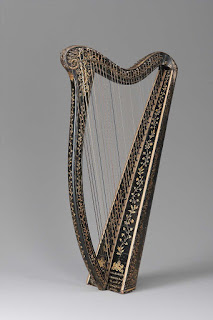
Blind Irish Harpist Matthew Wall Performs and Teaches in Boston in 1832

Image
Irish Harp by John Egan  Courtesy  of Museum of Fine Arts Boston ( Researched by Michael Quinlin ) One of the first Irish musicians cited in public records to perform and teach Irish music in early 19th century Boston was Matthew Wall, a blind harpist who emigrated to New Brunswick in 1830 before eventually making his way to Boston.    The Boston Evening Transcript, October 6, 1832 issue, ran a notice announcing Wall would be performing at the State Museum, corner of Court and Howard Streets in Downtown Boston near Scollay Square. Wall was described as "a celebrated performer upon the Irish Harp. As this is the first instrument of its kind ever in this country, the lovers of Music will do well to avail themselves of this opportunity to witness the sweetness of its tones...This was the instrument used by the bards of olden times, and is well calculated to touch and arouse the feelings." The same notice ran on page one of the October 12, 1832 issue. ...